What to Expect From a Content Marketing Agency in the First 90 Days
Before I started LowkeyLabz, I was the client.
I worked in procurement for a UK travel company, sourcing hotels and suppliers across Europe, the UK and Scandinavia. A big part of the job was deciding which vendors we could rely on.
In procurement, the vendors worth keeping were rarely the ones with the best pitch. They were the ones who asked good questions early, told you exactly what they needed from you, and didn’t go quiet when something slipped.
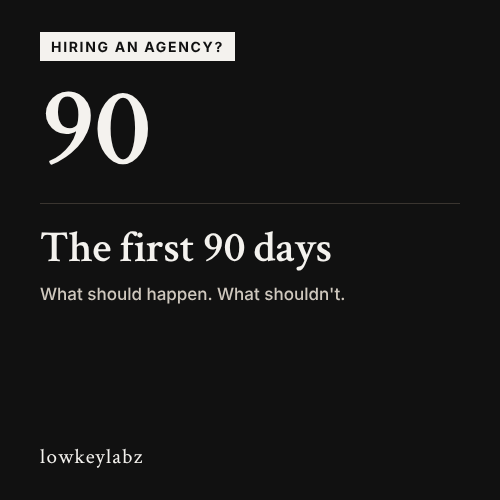
Hiring a content marketing agency is no different. If you’re a coach or consultant about to sign with one, the first 90 days will tell you almost everything you need to know. Here’s what each month should look like.
Month one: more questions than posts
A good agency’s first month looks slow from the outside. That’s a good sign.
Before anyone designs a carousel, they should be asking you things like: Who exactly do you help? What’s going wrong for them when they start looking for someone like you? Why do clients pick you over the three other people they spoke to?
If the kickoff call opens with “So, how many Reels a week?”, be careful. Content made without those answers is decoration.
By the end of the month, you should be holding:
- A plain-English summary of your audience: their problems, their objections and the words they actually use.
- A short list of fixes for your LinkedIn, Instagram and website. Often the real problem isn’t too few posts. It’s a vague headline, or no obvious next step for someone who’s interested.
- Three or four content themes, and a posting schedule you can realistically keep.
You have homework too. Block 60 to 90 minutes for a proper kickoff, share access to your accounts, and write down the questions clients ask you most on sales calls. That list is worth more than any trend report.
Month two: a rhythm that doesn’t depend on you
This is when content starts going out.
Most coaches and consultants know their subject inside out. Turning that into a 45-second video or a carousel someone stops scrolling for is a different skill, and it’s the one you’re paying for.
Your part should stay small. You talk for 15 minutes about a problem you solve. A week later that conversation has become a short video, a LinkedIn post, a carousel and a follow-up post, and all you’ve done is review and approve.
If you find yourself chasing the agency for drafts in month two, take note. It rarely gets better on its own.
By the end of this month, they should also be telling you what they’re noticing. Which topics get real comments, not just likes? Which videos do people watch past the first few seconds? Is anyone from your target audience visiting your profile?
Month three: from posting to performance
Now there’s enough data to stop guessing.
Say your posts about common business mistakes keep pulling thoughtful comments, while the motivational ones get polite silence. A good agency leans into the first and quietly drops the second.
Month three is also when you look past the posts at the whole path: someone sees a post, visits your profile, checks your website, and gets in touch. Somewhere along that path, people are dropping off.
| If people… | It usually means… | The fix |
|---|---|---|
| Like your posts but never visit your profile | The posts don’t connect to what you sell | Tie each post back to the problem you solve |
| Visit your profile but don’t click through | Your headline says too little | Say who you help, with what, and the result |
| Reach your website but don’t get in touch | The next step is unclear | Make booking a call one obvious button |
By day 90, you should have a short list of topics that are working, a few fixes to that path, and a plan for the next quarter built on what actually happened.
What’s realistic by day 90
Realistic: clearer positioning, steady publishing, and early signals like saves, thoughtful comments, profile visits and the occasional DM from exactly the right person. Some businesses land a first inquiry in this window. Plenty don’t yet, and that’s normal.
Not realistic: a promised number of followers, leads or sales. Results depend on your offer, your market and where you’re starting. Blog traffic from Google takes longer still.
What you publish matters more than how much. In the 2026 Edelman–LinkedIn B2B Thought Leadership Impact Report, 59% of final decision-makers said weak or missing thought leadership helped get a vendor dropped from consideration (Edelman–LinkedIn, 2026). Rushing out generic posts to hit a quota can cost you clients.
When to walk away
I’d be worried if an agency:
- Starts posting before it understands your audience.
- Sends reports full of likes and follower counts, and nothing else.
- Guarantees leads, growth or “going viral.”
- Can’t tell you who approves what.
- Produces posts that could belong to any coach in any niche.
Five questions to ask before you sign
- How will you learn about my business and my clients?
- Who actually writes and designs my content, and how will you get my voice right?
- What exactly is included: strategy, writing, design, publishing, reporting?
- How will we measure success beyond likes?
- How often will we sit down and review what’s working?
A good agency will be glad you asked.
The bottom line
Don’t judge your first 90 days by how many posts went out. Judge them by whether you understand your audience better, have a content system that runs without you chasing it, and can see what’s starting to work.
That’s the order I work in at LowkeyLabz: clarity first, then consistency, then results we can measure.
If you’re a coach or consultant and want your expertise to bring in better-fit clients, book a strategy call with LowkeyLabz. I’d love to hear what you’re building.
Tushar Chauhan is the founder and creative director of LowkeyLabz, a creative studio that helps consultants and coaches turn their expertise into content, brands and websites. Before LowkeyLabz, he worked in business development, real estate sales and international procurement. He is a Meta Certified Digital Marketing Associate, based in India and working with businesses in the US and UK.